Reactor pressure vessel external cooling test facility
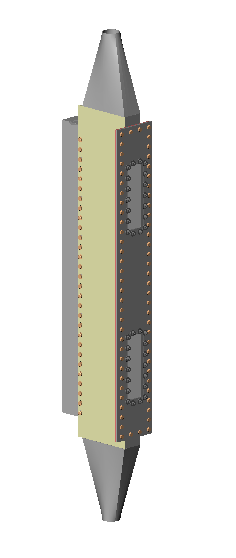 The purpose of the test facility was to study the external cooling of a VVER-440
nuclear reactor pressure vessel. The test facility was built in Lappeenranta University
of Technology and two test series were conducted with it, the first one in 2007 and
the second one in 2008.
The purpose of the test facility was to study the external cooling of a VVER-440
nuclear reactor pressure vessel. The test facility was built in Lappeenranta University
of Technology and two test series were conducted with it, the first one in 2007 and
the second one in 2008.
The facility was an axially symmetric model of a part of the pressure vessel
wall and the corresponding part of the reactor cavity. The pressure vessel wall
was represented by a rectangular steel bar 100 mm wide, 150 mm deep and 1500 mm
tall. Material properties were matched as closely as possible to those of the
steel used in the real pressure vessel. A flow channel representing the reactor
cavity was attached to the steel bar. The parts were insulated from each other to
limit the heat transfer from the bar to the channel walls. The back wall of the
steel bar was electrically heated to simulate the transient during normal operation
of the reactor. The heater block consisted of a flat aluminum bar and six heater
rods with a nominal heating power of 1 kW each.
26 thermocouples were installed inside the steel bar. Four of the thermocouples
were installed in slots on the surface of the steel bar and the rest were put in
holes drilled through the side face. The thermocouples were arranged in rows. One
row was in the upper part and the other three rows were positioned in the lower
part in a grid formation. Six temperature measurements were put inside the flow
channel to measure temperatures near the wall and free stream temperature in the
channel. The heater was controlled by six thermocouples in the aluminum bar. Flow
rate was monitored and there was a differential pressure sensor on the flow channel
to measure surface level. There were two windows in the flow channel. A video camera
was used to record the events from the lower window.
In each experiment the steel bar was first heated to the correct temperature
distribution. Temperature at the measurement surface was about 255 °C. When the
experiment started a valve was opened and water was pumped to the flow channel.
Flow rates between 0.1 and 2.37 l/s were used with water temperatures between
29 – 100 °C.
© Copyright LUT University